
How do stethoscopes work and why are they so vital?
More Than Just a Tool Around the Neck. Understanding the Vital Role of Stethoscopes
By Balavignesh Baskar
Stud. Med., Chief Medical Officer of AUSCORA

On this blog post we answered the most asked questions about stethoscopes:
- What are stethoscopes?
- Who created stethoscopes?
- How do stethoscopes actually work though?
- What are the advantages and disadvantages of using stethoscopes?
- How new technology solves these cons?
The iconic tool that is owned by every doctor. Most doctors’ best friend and best tool. The first bedside tool that serves as a symbol to the medical field. Yes, I am of course talking about stethoscopes. Stethoscopes have been a trusty companion of a doctor for more than 200 years, making it one of the few medical devices with such remarkable longevity. As a doctor you are introduced to these indispensable instruments quite early – most of them already when we have just begun our journey as medical students. But not everyone knows how stethoscopes actually work and how we are able to hear sounds so clearly. In this blog, we will dive deeper into this topic.
What are stethoscopes used for?
For aspiring medical students or those interested in healthcare who are curious about stethoscopes, this is a brief overview of their role in a doctor’s daily practice.
Stethoscopes are an integral bedside tool, which is often used in the preliminary diagnosis process. It is usually the first used tool when a patient arrives with distress in the thorax area (the upper body). Although it never stands alone, when diagnosing, it proceeds to be an invaluable tool in a physician’s everyday work. Doctors use it to hear sounds that are generated internally by lungs, heart and the gastrointestinal tract. It can also be used as an effective tool for measuring blood pressure.
Stethoscopes allow doctors to evaluate the heard sounds based on:
- Frequency: whether the pitch is high or low
- Duration: In terms of how long a sound is heard
- Quality: how clear is the sound?
- Intensity: the loudness of the sound
- Number: how many times the sound is heard
In newer times we experience a fall in usage of stethoscopes for the gastrointestinal tract, as we often hear sounds of peristalsis (involuntary muscle contractions that move food down the digestive system). However, stethoscopes remain a vital tool when performing lungs and heart examination.
Who created the stethoscope?
To better appreciate its importance, it’s worth asking, who invented the stethoscope? Imagine this, you are a doctor in the early 1800s, and you have to hear every patient’s heart by placing your ears close to the patient’s chest. You would also get uncomfortable, wouldn’t you? So, did a French physician in 1816 called Rene Laënnec and therefore created a prototype of the current stethoscope.
This allowed him to place the chest piece of the stethoscope on the patient and get a clearer image of what sounds the heart and lungs made. Although these sounds are common knowledge amongst physicians now, it was almost unheard of in the 1800s.
This prompted Laënnec to publish his book, De L’auscultation Mediate (On Mediate Auscultation), on the use of listening to body sounds. This consists of heart and lung sounds and how they should be interpreted.
How do stethoscopes actually work though?
To all the curious minds out there, like myself, who love to learn how the medical devices actually work, this paragraph would be perfect for you.
A very important piece of the stethoscope is the tube, which is hollow. This connects the earpiece to the stem. The hollowness of the tube allows for the vibrations of the sound to bounce off the walls of the tube. This will create resonance, which amplifies the intensity of the produced sounds, allowing the user to hear a clearer sound of the vibrations. In a way the tube works as a tunnel, guiding the sound waves to the user’s ear.
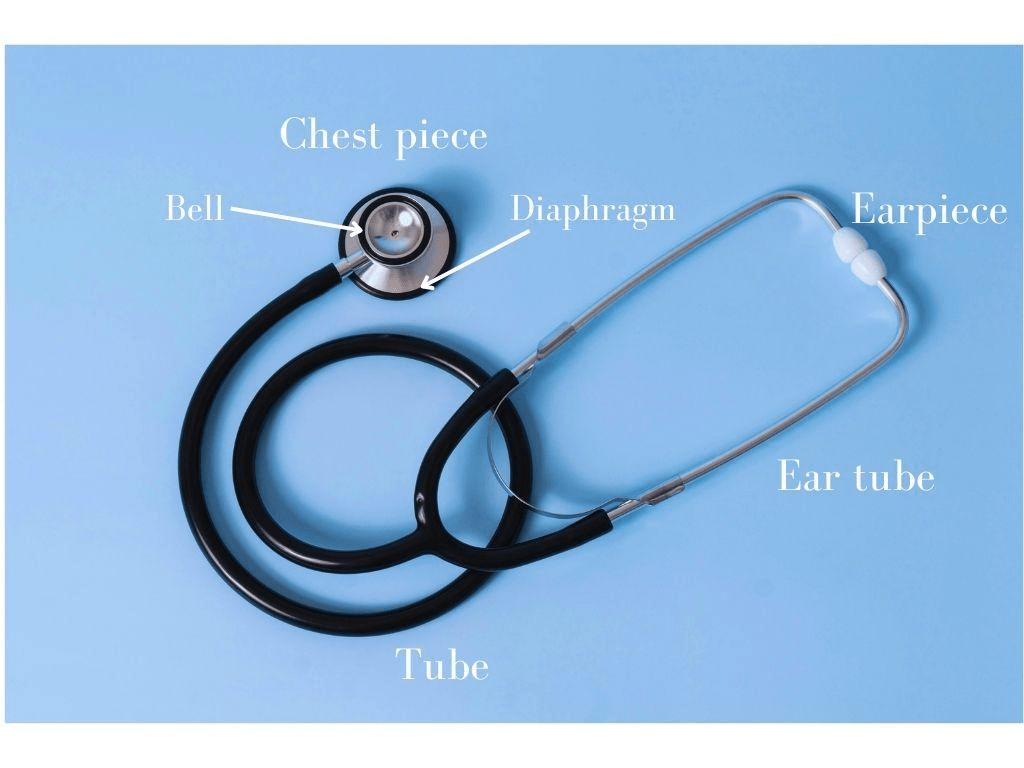
The earpiece is simple, yet vital, as it sends the sounds waves to the ear, allowing the user to interpret the sound.
The piece which is gently placed on the patient’s chest is rightly named as the chest piece. It has two sides: the diaphragm, the big flat circle, and the bell, a smaller hollow cup. The user can switch between the two “modes” all according to what the purpose of their use of the stethoscope is. The diaphragm used to hear higher pitch sounds, whereas the bell is used, therefore, to hear lower-pitched sounds. It is for that reason important that when using the bell, the user avoids pressing too hard on the skin. By pressing too hard, you will end up blocking the low frequency sounds and rendering it useless. Kind of like pulling out your phone to check the time, and suddenly you’re knee-deep in memes, emails, and an existential crisis, but still no idea what time it is.
Once the chest piece is placed on the chest, sound waves are picked up. These sound waves are created by multiple molecules that collide into each other because of the vibrations caused by the movement of an organ e.g. the heart. These are the sounds that the user will hear in their earpiece and will then have to interpret on, which is not always the easiest task.
Long story short, your organs make vibrations that turn into sound waves, the tube picks those up, and sends them to the earpiece.
What are the advantages and disadvantages of using stethoscopes?
Now that we understand how stethoscopes work, let’s look at what makes them both effective, and sometimes limited.
The advantages of stethoscopes are quite straightforward. They are one of the cheapest tools in a hospital especially when compared to ultrasound equipment, which start at 5000 € compared to traditional stethoscopes starting from 115 €. Furthermore, stethoscopes are way faster to use and are handy. They can be easily carried around in the pockets of the scrubs and using them couldn’t be simpler:

Step 1: Take the stethoscope out
Step 2: Put the earpieces in your ear
Step 3: Put the chest piece on the patient’s chest
Step 4: Listen and interpret
Because it’s easy to use, learning how to operate it is generally simple, though it may still take time to master. As mentioned earlier, their ability to assess the lungs, heart, and abdomen makes them also incredibly versatile.
While stethoscopes are a must-have tool in healthcare, they do come with a few downsides. One big issue is that the sounds you hear can be easily misunderstood. Since listening with a traditional stethoscope is pretty subjective, it really depends on the person using it. What one person hears might be completely different from what someone else picks up. This can lead to mistakes, especially if the user doesn’t have a lot of experience.
Another problem is that traditional stethoscopes can make it tough to hear really quiet sounds, like a faint heart murmur or soft crackling in the lungs. In a noisy room or with certain patients, these quieter sounds can be missed altogether.
How new technology solves these cons?
Although stethoscopes have outlived time itself, it is not until fairly recently we have begun to see a development. This development is mainly caused by the inaccuracies that are followed by using the traditional stethoscope as they entirely rely on the ability of the user.
Electronic stethoscopes
To aid the issues older physicians face in terms of hearing loss and to make sure subtle body sounds don’t go unnoticed, the electronic stethoscope was created. These more advanced stethoscopes amplify the heart and lung sounds, so the user can more easily hear the sounds. It also provides noise-cancelling features, by reducing the background noise. This supplies the user with a refined noise, which enables more accurate diagnosis. Some electronic stethoscopes also provide recording, which can be saved for later use or shared with other experts.
Digital stethoscopes
Digital stethoscopes are even more advanced tools, which can be used for more accurate diagnosis and in many cases can be used to prevent diseases from growing. Digital stethoscopes have similar features to electronic stethoscopes, in terms of recording and amplification of sounds. However, it uses artificial intelligence to analyse the heart and lung sounds. Thereafter the AI model will either give a potential diagnosis or a clear definition of what sound is heard. This allows the doctor to have a more structured approach for the diagnosis and treatment. It is valuable as a preventive measure, as AI stethoscopes are able to find minor heart murmurs, which can be found before it influences the patient’s body. This helps in early detection and therefore prevents further escalation of the disease.
AUSCORA is working on creating such an AI model, which will allow early detection of heart and lung diseases. This tool streamlines the decision-making process. This will reduce misdiagnoses, making it a valuable tool for every healthcare provider.
In conclusion,
Although stethoscopes have been seen more often as a tool only used as a preliminary medical device, new developments enable stethoscopes’ longevity to increase, such as the digital/AI stethoscopes. The theory of stethoscopes becoming obsolete is looking more and more to be just a myth.
Bibliography
(n.d.). Retrieved from Medisave: https://www.medisave.eu/
Adcox, S. (2024, September 18). What is Auscultation? Retrieved from WebMD: https://www.webmd.com/a-to-z-guides/what-is-auscultation
Roguin, A. (2006, September). Rene Theophile Hyacinthe Laënnec (1781–1826): The Man Behind the Stethoscope. Retrieved from PubMed: https://pmc.ncbi.nlm.nih.gov/articles/PMC1570491/
Stethoscope. (2024, 11 11). Retrieved from Cleveland Clinic: https://my.clevelandclinic.org/health/articles/stethoscope
Ultrasound Machine Price – Guide to Ultrasound Machine Cost. (2025, April 2). Retrieved from LBN Medical: https://lbnmedical.com/ultrasound-price-guide/
 AUSCORA